"Many people are using mindfulness in the workplace and benefiting from it" - Martine Batchelor

                                                                                          pic courtesy - budismosecular.org

Martine Batchelor spent ten years in a Korean monastery studying Zen Buddhism. She works as a lecturer and spiritual advisor, and her books include Principles of Zen, Walking on Lotus Flowers, and Buddhism and Ecology. She lives in the South of France. She speaks to Abhijit Ganguly.

Why has mindfulness become such a popular theme in our modern culture?

It has become a popular theme in our modern culture because it is pragmatic, portable, and secular. Although it is a practice which comes from the Buddhist tradition, one does not have to be a Buddhist or believe in the Buddha to cultivate it and benefit from it. Jon Kabat Zinn, the founder of this modern and applicable mindfulness had very good results with his patients -- whether they were people with heart problems or were suffering from painful conditions. A friend of mine who suffered severe burns was given the choice between a course of mindfulness or more medication. She decided to try out mindfulness and it radically changed her ways of dealing with painful sensations. She found it a great relief and a revelation.

What are your views about bringing mindfulness into the workplace?

Many people are using mindfulness in the workplace and benefiting from it. First, it can help people to be more efficient and focused on the task at hand. Being fully present in a caring and careful manner, but also in a stable and open way helps one to take to the task with creativity and fullness, and leave it behind totally without regret, and then move on to the next thing.

Mindfulness also enables us to deal with difficult people and situations better.

Can it enhance leadership qualities?

It could if a leader is someone who cares as much for himself/herself as for others, who acknowledges that he/she can make mistakes as well as other people; but who can also have great ideas. It could enhance one’s potential for patience, endurance, wisdom and creativity.

Perhaps the most interesting intersection in the business world is between mindfulness and technology, as they appear to pull in opposite directions. What are your views?

Mindfulness and technology can go hand in hand, again, it depends how you use mindfulness and technology. I have various meditation friends who have developed meditative apps, which people find to be very useful to cultivate mindfulness on the go. Another friend developed a programme for a teenager called .b which works very well in school. You have Buddhist Geeks conferences. Mindfulness can also help to use technology more skillfully and wisely. Again, it depends what kind of technology one is talking about. There are different sorts of application of technology.

It seems like there is a general trend towards increased social responsibility for companies and their employees. What role do you think mindfulness plays in this?

In a Buddhist sutra, the Buddha mentions the six duties or responsibilities of the employer towards his employees and vice versa. In a later Chinese sutra (5th century CE), dedicated to the ethical precepts of the person aspiring to awakening one is enjoined to treat well one’s employees and to use resources wisely and compassionately. In more recent times, the Quaker industrialists in England wanted to provide jobs and do commerce with an ethical attitude.


Nowadays, there is also talk about social responsibilities for companies and their employees. The practice of mindfulness could be having some influence. If one cultivates mindfulness, one is cultivating a more caring and careful attitude which will encompass all activities and relationships including appropriate livelihood. In the USA there is a series of conferences called Wisdom 2.0 which is involved in these kind of discussions with Google and Microsoft and other companies for example.
0

A single engine Cessna, the globe, and a 21-year old daredevil


At 2l, Captain Tan has become the youngest person to fly solo around the world, completing a journey of more than 22,000 nautical miles in 50 days. Capt Tan’s historical flight in a single-engine Cessna 2l0 Eagle took him to 20 countries. He shares his experience with Abhijit Ganguly.

What inspired you to become a pilot?

I was amazed to see the Boeing 747 for the first time at the age of 5. When I was flying to the UK on a holiday, I saw a red fighter flying 90 degrees up in the air and I said to myself, “You know what, I'm going to become a pilot.” That was it.

What prompted you to make this journey around the world?

My journey around the world is an attempt to inspire persons with special needs and make them believe that they can also achieve their dreams. I wanted to do something to inspire and motivate people and convey the message to youngsters from all over the world that nothing is impossible. I would like people to see disability as a gift and dream because that is what inspires people to get direction in life. If I can do it, anyone can. I just wanted to promote the idea that you can do it if you believe in yourself.

Could you share with us some hair raising moments you had experienced during the journey?

I had faults with the plane's hydraulic system as I flew from Alaska to Vancouver in Canada. In one of the stopovers in Russia the temperature was as low as -20 degree Celsius. And while flying over the ocean, I saw it was frozen! The engine had frozen and wouldn’t work. I had to pick the ice with a screwdriver, before warming it up. And I had had to take off my gloves for all that, and I could feel the chill. I also encountered ash cloud from an active volcano in Russia and sandstorm while flying over Qatar.

How was your experience in India?

It was absolutely amazing!! I love India the culture and the history of your great country. Especially my visit of Calcutta where I had a rare pleasure of having a boat ride on the River Ganges. In that moment I found a moment of peace.

What advice would like to give the special need children who want to make it big in life?

Watch Taare Zameen Par, It’s a lovely movie and it spoke to me in a special way. I found this quote very helpful in my journey “The two most important days in your life are the day you are born and the day you find out why.”


Find your dream and never give up and some day you will make it happen!
0

AFL bounces into India


The game was officially born 156 years ago when in 1859 its rules were codified four years before soccer even had a codified set of rules, but it had been played for several years before that across the southern states of Australia . Originally a sport played by cricketers in their leisure time to stay fit, over the decades the game created a unique identity of its own. It may look something like rugby but the rules are completely different.  As basketball and baseball are popular in the US, so Footy is popular in Australia. During a visit to Australia in 2015, Christiano Ronaldo even had a chance to learn the game and Indians such as Harsha Bhogle and Bengal’s own Sourav ‘Dada’ Ganguly have also been introduced to the game by their Australian counterparts. The name of the game is Australian Rules Football. In short, “Aussie Rules” or simply “Footy”.


                                        Gavin Crosisca
Recently the  Australian Rules Football Association of India National Championship 2015,  was held at Gitanjali Stadium, Kolkata. Australian Football League legend Gavin Crosisca who was in attendance  said, “ I was here in 2013 with a tournament in Goa. The skills of the teams that were down there has improved considerably. The training that these guys have been putting in is starting to show the rewards. I think that the tournament is improving considerably so it’s a credit to everyone who is involved. These two days of playing Footy is a fantastic thing for not just AFL but also for the Indian community because Footy brings communities together with a lot of camaraderie.”

The game is immensely popular in Australia where it originated and can draw crowds of up to 1 lakh spectators at the Melbourne Cricket Ground. It is now played in 51 countries around the world. It looks like a combination primarily of football and rugby but has elements of other sports as well. Unlike rugby, players can't throw the ball and can be tackled from all directions. For short passes, they have to hit the ball with their fist (called a ‘handpass’) similar to volleyball. For long passes, they have to kick the ball like a football goalie. They are also supposed to bounce the ball every 15 meters like basketball. With an oval shaped ball the ability to bounce the ball is a skill in itself.

                  Sudip Chakraborty
Sudip Chakraborty, Founder & Secretary General at Australian Rules Football Association of India (AFL India) & Captain of the national team of India- Indian Tigers, told “ Ricky Ponting in 2008 first played the sport here when he was playing for the Kolkata Knight Riders. In the same year, a coach from Australia came to Kolkata and the sport was launched in Kolkata  and players from all sporting backgrounds were invited to try the sport. Similarly, a friend of mine who was a basketball player asked me to give this sport a try because there seems to be an advantage for tall people. I am from both soccer and cricket backgrounds but I still gave it a try. Since this sport involves skills from various different sports, everybody has a part to play. First a team representing India was formed, which was supposed to travel to Australia. I got selected and we went to Australia and witnessed the madness of the game there. I started liking it and thought we can't just let it be a one-shot deal and that we needed to go back and develop it. Unfortunately, people who were in charge back then lost interest and nothing happened for one and half years. We wrote to the AFL and were given the charge.”

There are seven states playing the sport right now (Jharkhand, Bengal, Odisha, Rajasthan, Maharashtra, Tamil Nadu and Kerala ) and in the last three years, the participation has gone up from around 1000 to 7000. The Indian Army has shown an interest in playing the sport. The Indian team named Indian Tigers goes to Australia every three years to participate in the AFL International Cup. Eighteen countries participate and Indian Tigers got its first victory against East Timor in 2011. Both the senior and junior division finals were between West Bengal and Jharkhand. Jharkhand won the junior division (61-0) while the Bengal boys won the senior division (18-14), making it three times in-a-row. 

Talking about the USP of the sport, Sudip said, “It is the fastest outdoor team sport on earth. Wherever you are on the ground, the ball could be within three seconds over your head. The ball travels so fast and high, it looks really attractive especially for someone watching from the gallery. It involves skills of various different sports for example, rugby, volleyball, basketball, soccer, sprinting etc.” Sudip is trying to have a state tournament every year and then, select the national players. For West Bengal, he is looking to start a league as players tend to lose motivation as they play one or two tournaments a year.

Shane Sayner, a spectator in Kolkata, an avid AFL lover and regular traveler to India, told  “It's great to see how the game has developed over the last few years in India since I first saw it in Goa in 2013. Much credit must go to the local coaches in each state, the players families, the supporters and former players who have stuck with the game and Sudip’s team at ARFAI who keep things going and growing on a day-to-day basis. Most importantly credit goes to these players who have come to love the game and stuck at it, improving themselves and this new sport in India”.


4

“As long as the artists do their home works with getting to know the other culture, working together can create wonderful results.”- Latif Bolat


The musical traditions of Turkey have been brought to the United States by Berkeley, California based multi-instrumentalist, vocalist and folklorist Latif Bolat. A teacher at the Mendocino Middle Eastern Music camp and Honolulu Music And Dance Camp, Bolat is the director of the Latif Bolat Turkish Music Ensemble of San Francisco and the musical director of the Mevlevi Association Of America, a Sufi organization the produces public performances of dance and Turkish classical music. Bolat was heard on the soundtrack of the George Lucas-produced television series, "Young Indiana Jones". Bolat, who holds a degree in folklore and music from the University of Ankara, was active in the music of Turkey before emigrating to the United States. In addition to teaching traditional music in Eastern Anatolia, he served as manager of Ankara Halk Tiyatrosu, a musical theater company that specializes in traditional musical plays. Shortly after moving to the U.S., Bolat received a grant from the California Arts Council for his work in preserving Turkish folk music.

You have been an M.B.A from San Francisco State University, worked as a computer expert for 22 years in the United States. How did your tryst with sufi music happen?

Turkey is like India, a very musical culture. Therefore we grow up in all sorts of music, including the Sufi genre. Actually secular and spiritual genres are mixed in a sense. Therefore without knowing everybody grows up listening such music and lyrics. In the USA, there was a wonderful interest by a small group of people. They sort of pushed me into the Sufi music tradition which I was already familiar with. The more I got involved the more I started appreciating.  And since then getting into even more with the philosophy, poetry, history and stories.


The music of the Sufi is practiced across the entire Islamic world, from Senegal to Indonesia. How would you explain the special features of Turkish Sufi music?

Actually, as a music genre, Sufi music also carries the Turkishness in it. That means technically it is in the same modes etc as the secular music of Turkey. Maybe the most defining part of it is the lyrics.
Poetry used in Sufi music is very old and very different from the general folk or court music tradition. Therefore with strong melodic structure Sufi music can create magic.

There has been an overload of the term “Sufi” in India in the recent times — Sufi-Rock, Sufi-Kathak, Sufi-Bollywood, Sufi-Festivals at the big metros.We're seeing considerable fusion being applied to traditional music forms now — what are your views on this trend?

Globalization has been designed to do exactly what you are mentioning. Under the name of global culture, globalization watered down everybody’s traditions in every aspect; music, dresses, food, behavioral patterns etc. By creating a very similar society around the globe, Globalization creators aimed a unified market where they can have no cultural or commercial barriers to sell their stuff to all of us.  That's why nothing sacred for the commercialization. In Turkey Whirling Dervishes dance in cafes, restaurants, weddings etc. It was supposed to be a sacred ritual. But it became a money making tool.  I really strongly against such developments. I am very much into the genuine cultural exchange among cultures. As long as the artists do their home works with getting to know the other culture, working together can create wonderful results.  Actually such fusion has been happening for the past several thousands of years anyway, nothing new. That's why Turkish, Persian, Arabic and Indian music and overall cultures have lots in common. We owe these commonalities to those wonderful people who got together in caravanserais or the old-time-hostels and exchange their talents by working together.

Hows been your experience performing in India? Do you have plans of collaborating with Indian musicians?

Playing in Ruhaniyat in India has been my annual highlight of my musical career for the past 8 years or so.  It is very satisfying in terms of the presentation, other musicians and the very receptive audience. Playing the ancient Turkish music and poetry in places like Purana Qila in Delhi, or close to Golkonda Fort in Hyderabad, or any ancient locations in India is like a dream for me.  It takes me into a wonderful time-traveling back to the times of the Great Akbar, Kabir, Amir Husrev.  This is alone an enough reason to come back every year.


0

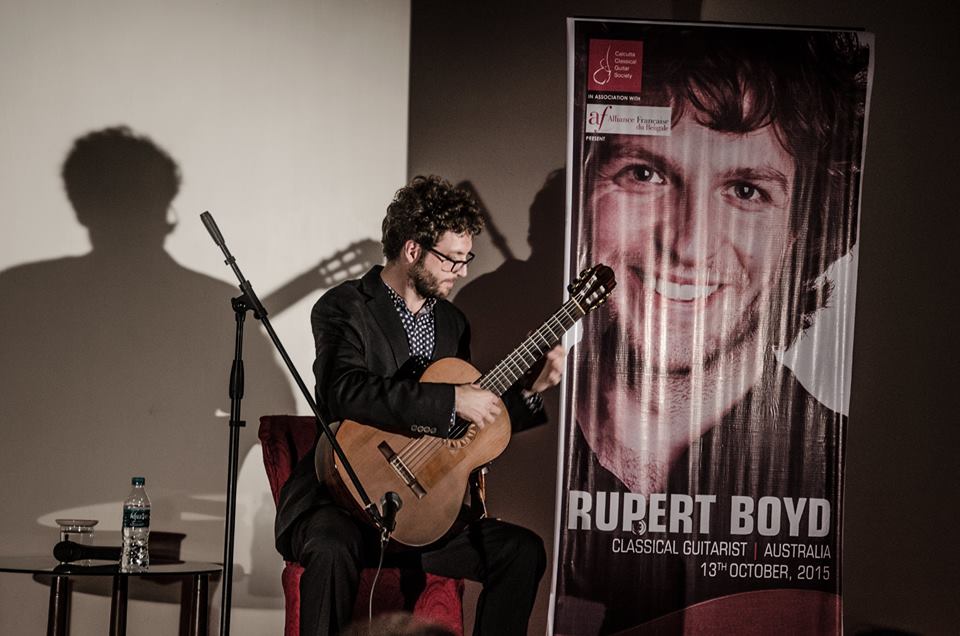
The one piece of advice I think important for classical guitarists is to play chamber music- Rupert Boyd

                                                                                                                                      Photo: Calcutta Classical Guitar Societcy
New York-based Australian classical guitarist Rupert Boyd is acclaimed as one of the most talented guitarists of his generation. He has been described by The Washington Post as “truly evocative,” and by Classical Guitar Magazine as “a player who deserves to be heard.” His performances have taken him across four continents, from New York’s Carnegie Hall, to the Barcelona Guitar Festival in Spain, Strings-139 Festival in China, Festival de Musique Classique in France, and every state and territory in mainland Australia. Active as both a soloist and chamber musician, Rupert Boyd regularly performs throughout the world as half of the Australian Guitar Duo with guitarist Jacob Cordover. The duo has performed throughout the world, including appearances in the United States, France, Spain, China, The Philippines and all throughout Australia. The duo was a prizewinner of the Chamber Music section of the Australian Guitar Competition, and their debut CD Songs from the Forest was released in March 2012 and was described as “wonderfully entertaining” by Classical Guitar Magazine, and “very impressive” by Soundboard Magazine.Recently, Calcutta Classical Guitar Society in association with Alliance Francaise du Bengale presented Rupert Boyd live in concert for the first time in Kolkata.

What is it that drew you to the classical guitar and what do you love about the instrument?

I really love so much about the guitar. I think what initially drew me to the instrument is that it is one of the most personal and intimate of all instruments, and can create a vast range of beautiful colours and sounds. The guitar too is so universal, and can be used to play most styles of music. As a classical guitarist though, I love that we can play music written 400 years ago, or music written yesterday, and works written all around the world.

Who or what are your inspirations? What is that inspires you?

I have many inspirations, a lot from pop music including Jimi Hendrix, The Beatles, Miles Davis, Bob Dylan, etc.. I also love art and visiting museums on my travels around the world. While a completely different medium, I love finding paintings that communicate something to me, and make me feel an emotion or experience. In terms of classical guitarists, I think we all owe a great debt to the Spanish guitarist Andres Segovia, who did so much to make the classical guitar be considered a serious classical instrument, and I also love the recordings by Julian Bream, which are filled with expression, nuance, and imagination.
                                         photo: rupertboyd.com


We hear people say that many guitarists today are overly concerned with precision and accuracy, perhaps due to recordings, but at the expense of beautiful, artistic playing. Do you agree?

I do think there has been a huge increase in virtuosity on the classical guitar over the past few decades. The pedagogy and standard seems to be higher than it has ever been. It’s a common criticism levelled at competition winners that they are overly concerned about precision and technique at the expense of musicality, but I think this is not just limited to the guitar, nor even limited just to musicians. I personally find that I enjoy performances of musicians who really have something personal to say, and I seek out those players. There does need to be a certain level of proficiency in a concertising musician, but I personally much more enjoy hearing someone really express something through music even if there are some occasional slips here or there, than hearing someone who merely plays every note with complete accuracy.

When you compose music, where does it come from? Do you spend much or any of your time in formal composition as opposed to improvisation becoming the composition?

At this stage of my life, I don’t compose a lot of music. Instead, I’m loving playing compositions from the canon of works written over the past 400 years, and still have so many more that I want to learn. I am open to the idea  of composing though, and feel that one day either the inspiration will suddenly take me, or I’ll devote the time to writing some of my own works.
                  Photo: Harold Levine


What recent trends have you been noticing with respect to classical guitar scenario?

There has been a great increase in the amount of wonderful guitarists on the scene today. Nowadays with YouTube and social media, it’s possible to see so many great guitarists all around the world, and really interesting to see the different repertoire that everyone is playing. There is of course, a core repertoire of pieces that you see many people playing, and usually these are the really great works that we can play on guitar, but it’s also great to see what local music different guitarist are playing from where they live. Especially in my ensemble the Australian Guitar Duo, I love to play contemporary compositions by Australian composers like Phillip Houghton, Ross Edwards, Nigel Westlake, et al, which are often not well known outside Australia, but every bit as good as anything being written for the guitar in this day and age.


Your word of advice for aspiring classical guitarists?

The one piece of advice I think important for classical guitarists is to play chamber music. As classical guitarists it’s very easy to spend so much time practicing and performing alone, that we often don’t get to have the experience of playing music with other musicians. The great thing about the guitar is that we can play in so many different ensembles. Over the years I’ve been fortunate to have played in duos with many instruments, including violin, cello, flute, voice, guitar and even some more unusual ensembles with accordion and soprano saxophone. In addition to being a very enjoyable experience, it can also be a great learning opportunity to play with other instruments and be able to try to work with the technical limitations inherent to all instruments.


0

“Keep studying hard and develop your skill, your ideas and your creativity!”- Shanti Colucci


Ingranaggi della Valle is a new young band from Rome with Flavio Gonnelllini on guitar, Mattia Liberati on keyboards, Antonio Coronato on bass, Marco Gennarini  on violin, Alessandro Disciullo on guitar and keyboards, Paolo Motta on vocals and  Shanti Colucci on drums and percussion. The band plays jazz fusion and funk / rock evolving their style moving to a new way of composition which binds vintage prog and jazz with a new and personal style. Recently, Shanti was in Kolkata.

You started to play the drums very early in your life. How did playing the drums evolve from being just a hobby to a professional career?

My passion with music started very early in my life thanks to my parents. I spent with them a lot of time listening to many different kinds of music, from rock to jazz and also Indian classical music. But when I was 14 I realized that only listening was not enough for me and soon I started playing drums because I was mostly fascinated by rhythm and my real dream was playing and making music. In few years thanks to my master Gianni di Renzo and to my dedication I realized that music was my life and I would have spent my existence on it. So after high school I attended the Conservatory of Frosinone and the Saint Louis College of Music in Rome where I continued studying with my master that is the starting point of my career.


Who are the musicians that inspire you the most?

My influences are very heterogeneous because since the beginning I used to pay attention to different styles and kind of music, also from very different areas in the world. But after a period spent mostly on rock, progressive and jazz-rock, being influenced by many great musicians and drummers like Phil Collins, Vinnie Colaiuta, Dennis Chambers, Chick Corea, Weather Report, John Mclaughlin etc., now I'm more focused on modern and traditional jazz. Nowadays my great source of inspiration are on one side those who belongs to the bebop and hard-bop era (Miles Davis, John Coltrane, Wayne Shorter, Philly Joe Jones, Tony Williams and so on) and on the other side those who are the new generation of jazz musicians: Tigran Hamasyan, Mark Guiliana, Jeff Ballard, The Bad Plus, Eric Harland, Avishai Cohen, Brad Melhdau, Kneebody, just to name some of them. For me it's always important to have multiple influences and I'm always searching for new bands, new music, new inspiration. Moreover, since I started playing Indian music I soon began to be influenced by the greatest Indian musicians, like Zakir Hussain, Selvaganesh, T.H. Vikku, Shankar Mahadevan, Trilok Gurtu, etc.

What sparked your interest in Nagara in the first place?

The first time that I heard Nagara I was in Pushkar. I was wandering in the bazaar and on the ghat when suddenly a groovy rhythm with beautiful and particular sound came in my ears. After a while, searching for the origin of that sound, I discovered Master Nathu Lal Solanki playing in a temple for the evening puja. He invited me to join and jam and he soon became my teacher because I was so fascinated by that sound and those rhythms. I went in Pushkar 4 times only for playing and studying with him Nagara drums.


How did your tryst with tabla happen?

After some years spent on Nagara it became not enough for me practicing only once a year in India and when I came to know that a great tabla player from Kolkata was living in Rome very near to my
home I decided to move to tabla. When I met this fabulous musician, Sanjay Kansa Banik, I suddenly realised that now I would have had the occasion to study Indian classical music without any interruption. 


What is your opinion regarding tabla in a non classical role on the fusion music scene?

For me tabla is the most expressive and dynamic percussion in the world and it can be used in every kind of music, not only in Indian classical music. Tabla gives a beautiful and harmonic sound to music and above all it gives you a lot of new ideas and rhythmical concepts that can easily be used on drum set and in western and fusion music. Trilok Gurtu is my favourite fusion tabla player and also Zakir Hussain tried to follow this way.

What are the current projects you are undertaking?

Nowadays I'm part of the Ingranaggi della Valle, a rock progressive band which is going to record its second album after having a great success with the first one. With this band I'm starting trying use
Indian percussion on my drum set. Moreover I'm the drummer of Blacknuda, a rock-new wave band which is releasing its debut album, and of Jazz It Up Quartet. This last project that started about 3 years ago is about modern jazz and proposes original tunes and many jazz standards completely renewed and rearranged. With the Jazz It Up Quartet we won an important competition for new young talents of Italian jazz, "Concocorso Chicco Bettinardi 2015" and now we're planning to record our debut album.

How was your experience at the Drummer zone clinic here in Kolkata ?

It was a very nice experience to have my first clinic in my life in Kolkata. Thanks to Nilanjan Ghosh and Tushar Banerjee, the founders of the Drummer zone Project, I had the occasion to share my music
experience with about twenty Indian drummer. I hope that in the future I would have the occasion to show more things to the "drummer family of Kolkata".

Do you have any tips for anyone who wants to expand their skill-set and become a multi percussionist?

Just experiment new sound and use it musically! Keep studying hard and develop your skill, your ideas and your creativity! Listen to lot music and play consciously with your head and your heart! Always practice rudiments and pay a lot of attention to the timing!
0

"Indigo is the world’s only natural blue dye" - Jenny Balfour-Paul


Jenny Balfour-Paul, Honorary Research Fellow at Exeter University, UK, Fellow of the Royal Geographical Society, Royal Asiatic Society and  the Explorers Club and President of the UK Association of Guilds of Weavers, Spinners and Dyers, is author of two books on Indigo. She is a partner in ‘Silk Road Connect’, an educational initiative launched in 2009 by cellist Yo Yo Ma’s Silk Road Project, was consultant for the Whitworth Art Gallery’s 2007 UK touring exhibition ‘Indigo: A Blue to Dye For’ and the American 2011 documentary ‘Blue Alchemy: Stories of Indigo’. She researches dyes in shipwrecks, promotes revivals of natural dyes worldwide and is author of a forthcoming book about a nineteenth century traveler and indigo planter in Bengal.  She guest-edited the special issue of the Indian quarterly arts journal MARG, on natural dyes of the Indian subcontinent. Abhijit Ganguly spoke to Jenny.
 
How did you develop your passion for colours?

I had a childhood yearning to go to India. As soon as I left school I travelled there overland on the 
hippie trail. I spent six months altogether away from home, aged eighteen and alone in India and Sri Lanka. I didn’t have much money, and travelled in third class train carriages among Indian women who looked beautiful in their colourful saris. I marvelled that poor people could look so gorgeous, and relished the colours of India. That trip left a deep impression on me.
 
Back in England, I went to university but really wanted to go to Art College, so I went to classes in the evenings. I always had a love of craft, painting and colour. I planned to get a job back
in India, but actually ended up working in Jordan. In the Middle East I found colours of the desert, bedouin weaving, embroidery, Palestinian costumes and so on which I liked very much. I also learnt batik from an Egyptian artist when I was living in Jordan and became a batik artist. So I was working with dyes and colours but not natural dyes then. When I was later exhibiting and teaching batik fabric printing and dyeing back in UK I met an influential teacher, the late Susan Bosence, a renowned block-printer and dyer. I learnt block printing from her and used to help her with her indigo dyeing.  She loved indigo and encouraged me to return to Yemen where indigo traditions were dying out. That's how my indigo journey started. I ended up going all over the Arab world to record all I could about indigo there before it vanished. Then I travelled worldwide for my second book on indigo, which brought me back to India again.

What makes indigo so unique?

Indigo is the world’s only natural blue dye.  Today it’s needed, whether the source is natural or synthetic, to dye denim blue jeans. This is because no other blue dye has the qualities that indigo has. It never loses its blueness. It may be 3000 years old and it may fade but it’s always blue. Other dyes change colour as they age. It has a better future than many of the other natural dyes because it is a green crop. It is renewable and good for the land and therefore has great prospects.

How important have dyes been throughout human history?

Huge. I think the textile industry is the biggest industry in the world, for clothes and furnishings and so on.  Many cultures didn’t really have furniture, they just had cushions, hangings and carpets. Until 1850 (1900 in the case of indigo) they were all coloured with natural dyes. Dyes were carried across the world in camel caravans or ships and that made them valuable. For example indigo was traded from India to London via markets like Baghdad, Alexandra and Venice. It was one of the plantation crops using slave labour in the European colonies. When colonial powers reached the Caribbean islands, for instance Jamaica, indigo was the first crop grown there before it shifted to sugar. It has a sad association with Bengal in the past because it also used forced labour then.
 
Please elaborate the relationship of indigo with Bengal?

When the colonial powers lost their hold of the West Indies in the late 18th century, demand for indigo was huge. It was needed for all blue clothing, whether for fashion, working or service clothes, for the armies of Europe or for the navy blue of the British Navy. So where was the indigo going to be grown to make all this dye if it was no longer coming from the West Indies?  Clive had conquered Bengal in the mid 18th century and its land is perfect for indigo. Cultivation started in a small way in the early 1800's and it quickly shot up. By the 1840's indigo formed half of all exports through Kolkata. Then in the 1850's there was a series of bad years and the workers got even more discontented as they were forced to grow it and were underpaid, when what they wanted to do was grow rice. The indigo planter I have written a book about said " Now we are  going to kill the goose which lays the golden egg".  He was proved right by a serious uprising on the indigo plantations in 1859. Indigo was always a problem in Bengal because the rival crop, apart from rice, was opium and there were a lot of vested interests in opium because it was for needed for trading with China.

What are the biggest challenges?

The biggest challenge is that the world consumes over a billion pairs of jeans each year and there is no way we can cater to all that with natural indigo. I think that, as with organic food, we can’t make everything organic but at least some of it. And highlighting organic cotton and dyes creates awareness of the polluters who are using heavy pesticides on cotton, and toxic chemicals to produce synthetic dyes, with waste that contaminates soil and rivers. Raising awareness of the toxicity of non-organic cotton and dyes leads to developments to make non-organic ones less polluting.
Whats your take on the use of technology in this regard?

A lot of research is going on in many areas, including the field of biotechnology.  For example the bacteria that make an indigo vat work have been discovered. One day we might even be growing ‘natural’ indigo in a lab.
 
How was your experience at the Sutra?

The Sutra organisation does an amazing job and the 2014 meeting was a great success.  It combined the past and future of natural dyes and the launch of Marg Vol 65, No.2, ‘Colours of Nature: Dyes from the Indian subcontinent’.  The exhibition, talks and round-table discussions about unique dye sample books and other archives in Kolkata, especially at the BSI, show how important it is to preserve and conserve such records. The exhibition on sustainable fashion, the bazaar with its naturally dyed products, and the dye demonstrations on the rooftop of ICCR were really well organised and showed how natural dyes can be used practically in textiles and fashion today and in the future. I  was very encouraged by the excitement and interest Sutra aroused among the delegates, participants and outside visitors, including many from overseas. It was also wonderful to see students and schoolchildren involved, because educating the young is where it all starts. India – and especially Bengal – has such a richness of textile history and present day skills. Sutra draws attention to this both within India and worldwide.
0

copyright © . all rights reserved. designed by Color and Code

grid layout coding by helpblogger.com