Reliving lost Konyak customs

Dutch photographer and researcher with Konyak roots on their journey to rediscover lost customs of Konyak tribe.
                                                                                                         - Phejin Konyak with Peter Bos
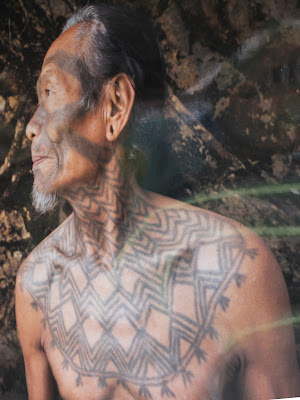
The spirit of Nagas came alive at the Indian Museum, Kolkata. A photo exhibition of the Konyak tribe of Nagaland, who were known for their tattoos on their face and hands, was exhibited at the Asutosh Centenary Hall. The photo exhibition by renowned Dutch photographer Peter Bos, who is also a collaborator in the research of Phejin Konyak, threw light on the head hunters of the tribe. 

Talking about what drove her to start this research, Phejin says, “When I went through old ethnographic and anthropological works like journals and books on the Konyak tribe it struck me that there is not much information on the tattoo tradition which is the fundamental part of Konyak society. This was a wakeup call. And it left me determined to research and document on the tattoo tradition and so I decided to work on tattoo culture which is becoming a vanishing art in our society”. Peter, talking about his association says, “I am mainly interested in shooting portraits of unique people/culture. I realized that cultures are disappearing very fast. India is the country where most varieties of people are living. India is my favourite country to travel. Travel is in my blood and seeking far places is what I like. I was in Mon district to shoot where I met Phejin. I heard about her ambition of writing a book on Konyak culture. I was fascinated about the head hunting of Nagaland and we planned a trip to all the villages where we found all tattoos of the Konyak tattoos surviving.”


The largest out of l6 officially recognized tribes in Nagaland, the Konyak are known as ‘those violent headhunters with tattooed faces.’ The Naga tribes head hunt not because of mass killing or purposely  killing people but it happens over dispute over property, fishing rights and for vengeance. Not all men have to go to war. Tattoos are very diverse in Konyak tribes. We have discovered about three tattoo groups, which has not been done by anyone before. The iconic men tattoo you see is the facial tattoo of a particular group. There are other groups with chest and arm tattoos. So basically for the men it is the right of passage or initiation. The warrior gets a distinctive tattoo mark depending upon his role in the battle. We have tattoos for the powerful chiefs. Common people or subordinates cannot get that tattoo. It is a taboo. When a girl turns eight she gets her first tattoo, when she becomes 11years or attains puberty she gets it on her chest, her arms, when she is about to get married she gets it on her knee signifying that she belongs to her husband now and when she is giving birth to a child she gets tattoo on her thighs, that’s for fertility.

Phejin explains, “The tattoo was a tradition for life and as for head hunting began declining tattoo culture receded. My society was the last to transcend into modern times and adjust with modern life. Now it’s not our way of life and we don’t encourage anyone to do it. We document it for preserving the culture of the Nagas. Our work is very precious and if we hadn’t heard their stories we would have never known the tattoo’s significance in their daily life.” Phejin is writing down a book on Konyak culture. Her main aim is to reach the maximum members of the Konyak tribe. There is going to be a series of three books, first for national and international quality, second will be cheap material for localities and third and illustrative children’s book. They will be making a documentary and an animated film. The children’s book will be turned into a documentary. There is only a handful of such full-body tattooed warriors left in Konyak tribes. Peter signs off, “I realized that this kind of tribal existence, visual appearance of it is

disappearing everywhere in the world. I like diversity as a photographer. Now I really feel the urge to go out and capture unique people. I think in a decade or two the world will be completely be changed and then specific unique characteristic of the people will fade out.”


Reviving traditional tattoos of the tribal people of the North East

At Hongpui Village with the former tattooed headhunters, Mon district Nagaland.

Mo Naga, an alumnus of NIFT-Hyderabad is a self-taught tattoo artist. He is reviving traditional tattoos of the tribal people of North-East, creating neo-tribal designs. His designs are exposing to the world the lost tattoos of Northeastern tribes. Recently Mo Naga was present here at an exhibition at the Indian Museum aimed at documenting the traditions of past generations of Konyaks an initiative by Phejin Konyak, a descendant of the tattooed headhunters of the Konyak tribe. She has worked relentlessly for conserving the vanishing art.Renowned Dutch photographer Peter Bos, a collaborator in the research of Phejin Konyak was also present..Abhijit Ganguly spoke to Mo Naga.

You are a qualified Fashion Designer from National Institute of Fashion Technology (NIFT) - Hyderabad. What prompted you to embark on a journey to protect, revive and promote tribal tattoos?

India has a diversified culture of tattoos from Kerala to Himachal Pradesh and from Gujarat to Nagaland, India has existing tattoo traditions. There are many tribes of the Naga community with rich tattoo traditions. I was overwhelmed by the opportunities that lay in front of me. It was the right time for me to shift from textile designing. Tattoos would reconnect me to my roots and give me an opportunity to showcase my work. I wanted to promote indigenous tattoo culture, prevalent among various tribes of the North-East. I am overwhelmed by the response and support that I have received. There is a need for urgency in everyone including the government bodies and the artists to revive the forgotten art of the Nagas which is slowly fading away.
 
Tattoo is a way of expressing
your feelings through your skin- Mo Naga
What is the present scenario of tattoo making?

The tattoo industry is booming in India. Tattoo is a way of expressing your feelings through your skin. For most people a tattoo signifies something deeper, much more personal and meaningful unlike the clothes or the makeup. Five -six years ago, people were fascinated by the bio-mechanical tattoo like, and then came realistic portraits and now people want to get Naga tribal style tattoos. The biggest misconception of tattoo is regarding health. There has to be more awareness about safe, hygienic and international standard tattooing.

What do you think is important for a tattoo artist while making a tattoo?

A tattoo artist must understand design concepts, body aesthetic, must have knowledge of art, and must be able to appreciate different art forms. 

Words of advice for aspiring tattoo artists?

To become a tattoo artist entails a long journey, lot of study, hard work and sincerity. It’s a profession that pays handsomely but is underestimated in society.

How was your experience getting involved with Phejin and Peter?

It was a great learning experience for me personally. I am grateful to Phejin and Sayan Bhattarcharya for arranging the workshop at the Indian Museum. Peter is a great photographer. I had great fun exchanging thoughts with both Peter and Phejin.

1

The Accordian : from Jazz to Baroque


                                                                                                             Photo courtesy - Madan Mohan Samanta
Mirco Patarini was born in Spoleto (Italy) and in 1978, he began to study music at the CDMI (Italian Musical Didactic Centre). In 1980, he started to study the free bass accordion and in 1981 was judged first in the Italian pre-championship of Castelfidardo. He won numerous prizes and awards in Italy. In 1988, he began to collaborate with the firm “Farfisa-Bontempi” as musical adviser and here he started his evolution through the world of electronic music. At the same time, he began his collaboration with the firm SCANDALLI. As a soloist, he has performed worldwide. Recently from2014, he has been the Chairman of the Music Committee on CIA (Confédération Internationale des Accordéonistes), IMC-UNESCO, and member of the CIA Executive board. Recently Mirco Patarini performed at the Sandre Hall, CSM. Kolkata.

How many different types of accordions are there?

There are really many kinds of instruments in the accordion “family” We can say that all instruments with free reeds and bellows are included in this family, also bandoneon (in all types) and concertinas. There is a really large quantity of “diatonic” instruments, or “bi-sonoric”: they are those small instruments that usually on the same key (button) play a note opening and another note closing the bellows. If we consider only the bigger instruments, we can divide in 2 types: one with Piano Keyboard, and one with button keyboard. The button one has various layouts: Italian French, Russian, and Finnish. The left part, usually called “basses”, has very often a common layout: 6 rows of button; two are basses, and 4 are the chords (major, minor, seventh and diminish); but in France, for example, they use a different layout, with 3 rows of basses and3 rows of chords, and also sometimes in Netherlands, even if one of the bass runs is different than on the French one…

In the “concert” instrument, played by concert artist or conservatory students, the left part has also a “converter” who can switch the chord rows (four) in single notes, to play classical or contemporary music. This system is called “free bass”, and unfortunately is not just one, but at least five. Then of course there are the various possibilities of combinations between the left and right layouts.

But this is nothing, if we enter into the matter of tunings. Various kinds of“tremolo”, “Musette”, “swing”, with or without “cassotto”: there really is a world of possibilities, and we should write a big book, to try to include all combinations.


How versatile is the range of music that can be played?

By the various kinds of instrument, is possible to play everything. From the music of baroque, classic and romantic periods to the contemporary music, from the folk of every country to the jazz. I heard an accordion sound in an unbelievable number of situations, even in Arabian music, because it is possible to tune accordions after an Arabica tuning scale.

How does the accordion differ in sound from an organ?

The accordion is not an organ: In the organ the sound is coming from the pipes, when in the accordion is coming by free reed. The sound of the accordion is closer to the sound of a harmonium. Another big difference is that the organ has usually a bellows activated by a person or by an electric Apparate, but in any case the air flow is constant, so also the volume of the music is always the same. In the accordion the bellows is activated by the player, and is used for the expression. We can say that is the same than the bowl for the string instruments, or the human blow for a saxophone or a brass instrument.

Was any classical music written for the accordion?

If we intend for “classic music” the music written in the classic period (between the baroque and romantic), of course not. The first patent of an accordion appeared in Wien on 1829 (by Cyril Damien) and it was just a kind of box with a few chords. Of course is possible to play really a huge part of the classic (and baroque, and romantic) repertoire of the piano, the clavichord, the  *harpsichord*, the organ, and also the chamber music.

When did composers start including the accordion in compositions?

Composers wrote for accordion since around 1850, we have entire books of original music. But in my opinion the accordion became the instrument that is today, just around 1960-70, and also in that period just a few musicians have been able to really play it. In any case there are examples of real good pieces written very well by real composers already in ’50.

Often thought of as a folk instrument when did you start seeing the accordion accepted as a full member of the orchestra?

If as “orchestra” we intend the typical symphony orchestra, the accordion is not a member, as the piano or organ as well. There are many pieces written for accordion and other instruments, including concerts for accordion and orchestra that are comparable to the operas for piano or any other soloist instrument. But I think you intend when the accordion has been finally accepted as an instrument at the same level than piano or violin or violoncello. I think this happened in different moments, depending of the Countries. In general in Europe just in the late ’70, or even ’80. But in the USA, for example, there is not yet any official course to get a degree, or a diploma at university level; and the same situation is in Australia or Nez Zealand. Or in South Korea, even if the instrument is quite popular. I can say that, for example, in the last 20 years the interest for the “concert” instrument grew very much, and in fact there are various universities and conservatoires who offer official courses till the final degree.
0

Making crisis work positively

                                                                                                                   pic courtesy news.com.au
Sam Cawthorn’s personal life journey changed dramatically in October 2006 when he was involved in a major car accident and died. He was resuscitated; but he had to live with an amputated right arm and a permanent disability in his right leg. He was hospitalized for over five months and confined to a wheelchair for close to a year.

But it is the story of Sam’s remarkable resilience, his mental strength as well as his physical recovery that has amazed and inspired so many Australians and people around the world. He is now a highly sought-after speaker and has spoken to over 50,000 people throughout Australia and overseas. He has been nominated for many awards and more recently, he won the 2009 Young Australian of the Year for Tasmania. He speaks to Abhijit Ganguly over a cup of coffee at The Chocolate Room, Kolkata.

With the poor economic situation and lack of jobs, how far can motivational exercises help and what are your suggestions in this regard?

Crisis creates opportunity. Crisis is a good thing as it forces us to change what is not working. It makes us look at things differently. With economic slowdown happening across the world including India, we must look at how we can capitalize on this and make crisis work positively.

The fastest growing company in the history of time started in the middle of the biggest financial recession of our time. Groupon was offered USD 5.3 billion from Google, just 18 months from starting, and they started in the middle of the financial crisis. Motivational exercises are not just an injection of hype but in a motivational peak state, we can empower ourselves to push on, capture opportunities and have an unstoppable attitude in the face of tough times.

In the business arena, what qualities of prime importance should an entrepreneur possess?

Firstly, every business entrepreneur must realize that failure is good. It’s the most important way that we can learn. Another way of looking at it is what I like to call ‘Adversarial Growth’. This means that in the toughest of adversities, failures or problems can ignite some of the greatest growth periods in our lives.

Another quality of prime importance during this time is proximity. Business entrepreneurs must seek quality mentorship and be open to grow by hanging out with the right type of people. Proximity is power, the company that you choose determines who you are; you are the average of your five closest friends.

People hear a motivational speaker, get charged for one hour, and then they return to their routine lives. There are hardly a few who are truly inspired to change. What is your opinion?

There is a difference between a good and a great motivational speaker. A good motivational speaker will inspire but not produce long term outcomes. A great motivational speaker should not only inspire and empower but encourage transformation.

The problem is finding a great motivational speaker who knows the tools, systems and strategies to do this to their audiences in the long term. This is where quality training is needed for a good motivational speaker. A great motivational speaker leaves the audiences wanting more, keeps them in anticipation throughout and after talking for a few hours feels like a few minutes.

A great motivational speaker encourages his audiences to buy products for ongoing motivation and momentum based transformation. A great motivational speaker knows how to programme his audiences to remember tools and strategies long term. The question is not about whether a motivational speaker produces positive change, the question is how you can get a great motivational speaker within your proximity.

Frustration and depression have become silent killers. The challenge it is felt is not to get motivated but to stay motivated. What would you advise our readers?

Depression rates today are ten times greater then in the 1930's Great Depression. The mean onset age of depression 35 years ago was 29 years old, today it is 14 years old. Happiness and gratefulness are essential ingredients to counteract these ‘silent killers’. Not taking things for granted, realizing how blessed you are and making a decision to be happy are some ways. Staying motivated is a choice and an attitudinal decision. It’s not your condition but your decision that determines who you are.

So in summary, realize that crisis/depression is temporary and you go through it for a reason and a purpose, and that opportunity is just around the corner. Proximity is power and seeking mentorship, quality advice and hanging with the right people can inspire one to snap out of a tough time. 
0

copyright © . all rights reserved. designed by Color and Code

grid layout coding by helpblogger.com