“Many more females are freestyling and they are improving so so much”


Several Guinness World Record holder, Vice European Champion, Laura Biondo Is one of the top leading female freestyler in the world. Half Italian half Venezuelan, is an inspiration for young kids, boys and girls. Also an ambassador for the Freestyle Football Federation. Abhijit Ganguly speaks to Laura.

How did you first get into freestyle football?

I used to play football. I started playing when I was 10. I learned thanks to my father who taught me. I was basically the guinea pig of a Biomechanical Lab he designed to help player improve their technique. Through this method I also learned the basics of juggling. In 2007 I was injured and since I couldn't play I would go sometimes with my brother to kick a ball around. He used to freestyle so I learned my first tricks with him. I then met some freestylers and slowly form there got passionate about it and kept on going.

What’s changed since you started? Are more female freestylers now?

Yes, many more females are freestyling and they are improving so so much. Alot has changed. The level has gone up in a crazy ways and I very happy for that.

Freestyle Football is becoming much more professional in the way the sport is run. What do you think needs to be improved in the sport? 

I am a big defender of female rights so I think what has to be improved is that people organizing a competition consider more females and give them more space to have their own competitions.

What’s a good starting point for anyone interested in learning freestyle?

Interest itself is the starting point. People have to be curious about the sport and about learning about it to fall in love with it.

How is your experience to be part of Atletico?

My experience with ATK was amazing. The entire society, from the presidents to the social media team, was very nice. I really enjoyed my time there. It was an amazing experience...And the team won!

How do you see Indian football as you come from a country in which football is national sport?

I think Indian football is in the right was to become also in India very big like in European countries. The effort many people are putting to make football in India grow is very positive and it will bring big things to India.

2

Mechket in search of enlightenment in India


Music cuts across borders and finds a common theme everywhere. A visiting troupe of Tunisian Sufi musicians, who was recently in India, told that their members were struck by the essential spirituality of much of Indian music. And this is the country that sparked the Arab Spring, a phenomenon in which local music played a major role.

Slim Baccouche, the leader of the team, told Abhijit Ganguly, “The visit remains in me and for all members of the group as a memorable public reception. It made us communicate across geographical distances and differences of cultures and languages with the essence of spirituality. Musicians in the world share the same values and the same ethic, and that gives us even more faith in what we do. My meeting with Indira Naike allows me to consider a more realistic and fruitful exchange.”

The music almost always plays a pivotal role in protest movements, with songs and chants unifying dissidents in their rallying cries. Unlike movements of decades past, however, protest music made popular during the recent revolution in Tunisia, Egypt, and beyond spread virally with the help YouTube and Facebook. One country that strongly illustrates the will of the people to hear and create music is Tunisia. With increased freedom of expression, every art form in the country has seen a profusion of new creativity, from contemporary art and theatre to popular music and rap.

                                    picture courtesy - Sohham Pramanick

Mechket, which literally translates to sources of light, has taken up songs from the traditional Tunisian Sufi style, but merged them with other influences from the region.

Baccouche says of the band: “This is a group of musicians and scholars who have done research in different musical specialties either in vocal or instrumental and is particularly interested in the Tunisian Sufi heritage. What unites us is our common desire to convey a message of peace, reconciliation with the inner being through mystical experience. The effect of sound vibrations on the psyche provides us with a line of work and research.”

Talking about the compositions, he elaborates, “Our repertoire is varied. It ranges from sacred songs to semi-secular songs and are very popular because they come from the public, from the depths of Tunisian popular culture.
We seek to provide an interpretation of these traditional songs and present stories of personal challenges. The subjects are of course related to the invocation of Allah, praise of the Prophet, and chants music that leads the listener on a journey within.”

Sufi music is now enjoying a renewed interest. This is not a fad, but a return to cultural and religious roots. Young people are now rediscovering these songs through distribution channels such as specialized radios. “While this type of music was confined in a very specific context, we strive to establish that these Sufi songs no longer remain confined to the mosques and mausoleums and ceremonies but become subject of everyday listening” says Slim.

Currently, they are working on an ambitious group that is updating a genre inherited from Arab-Andalusia tradition: Malouf. But in this case specific texts will be replaced by          secular, religious texts that give these strong classical melodies a new dimension.


The band is also working on the very first written scores for Sufi brotherhoods dating back to the Kadériya and Chadhouliya of the early 19th century.
0

Missing Voices gives voice to Muslim women artistes


To be an artist today means facing some age-old restrictions, whether economic or social. Women, however, face specific challenges when it comes to artistic freedom. Add in religious conservative values and that makes things a bit trickier. For female artists who are also Muslims, there can be enormous challenges in bringing their work to the public space, and there have been some projects aimed at amplifying the stories and works of Muslim women. Annette Bellaoui is one such lady.

Annette Bellaoui is a Danish Muslim who is the founder of the “Missing Voices”, an international consortium of Muslim women for the purpose of promoting them in the world of music. Missing Voices were created in response to WOMEX 2007, where she was the only woman present wearing a headscarf.

How did the idea for “Missing Voices” come about? Annette says, “I started Missing Voices, because I realized how hard it is for women to make a professional career in music, and especially for Muslim women and women from a non- European background. I thought about how being a professional performer could be very empowering, both for the performer and for women in the audience.”

Annette Bellaoui was here with the Serenas band at the Sufi Sutra, the international festival of Sufi and traditional music which was held in Kolkata by banglanatak. Com.  Serenas is a band comprising women from Denmark and the United Kingdom. Serenas comprises members, Sarah Yaseen, Anja Mikkelsen (bass clarinet), Renu Hossain (tabla), Nina Norgaard Veng (flute), Pia Nygaard (violin) and Karen Jorgensen (accordion).

What were the most challenging things she faced? Annette says, “We still face many challenges. It is a continuous struggle. But I would say that the main thing is simply to get venue managers, festival managers and such to see the Missing Voices women as competent, talented professionals, and not “just women”. It is occasionally dangerous to do what we do, but mostly it is verbal abuse, and dirty emails. I ignore this, but if anybody physically threatens the Missing Voices artistes, I will report it to the police, and stand in the way of any thug. Nobody is allowed to touch or bother my girls.”

How has her professional career helped shape her views on faith and gender issues? Annette says “In the Missing Voices, we teach them to take charge of their own fate and career. Running an organization like the Missing Voices has mostly taught me not to take nonsense from anyone and to fight for what I believe is right. We believe that only the individual knows and can decide what is right for him or her. That is also part of the message we share with our audience, and the people we come in contact with in our work.”
0

Reliving lost Konyak customs

Dutch photographer and researcher with Konyak roots on their journey to rediscover lost customs of Konyak tribe.
                                                                                                         - Phejin Konyak with Peter Bos
The spirit of Nagas came alive at the Indian Museum, Kolkata. A photo exhibition of the Konyak tribe of Nagaland, who were known for their tattoos on their face and hands, was exhibited at the Asutosh Centenary Hall. The photo exhibition by renowned Dutch photographer Peter Bos, who is also a collaborator in the research of Phejin Konyak, threw light on the head hunters of the tribe. 

Talking about what drove her to start this research, Phejin says, “When I went through old ethnographic and anthropological works like journals and books on the Konyak tribe it struck me that there is not much information on the tattoo tradition which is the fundamental part of Konyak society. This was a wakeup call. And it left me determined to research and document on the tattoo tradition and so I decided to work on tattoo culture which is becoming a vanishing art in our society”. Peter, talking about his association says, “I am mainly interested in shooting portraits of unique people/culture. I realized that cultures are disappearing very fast. India is the country where most varieties of people are living. India is my favourite country to travel. Travel is in my blood and seeking far places is what I like. I was in Mon district to shoot where I met Phejin. I heard about her ambition of writing a book on Konyak culture. I was fascinated about the head hunting of Nagaland and we planned a trip to all the villages where we found all tattoos of the Konyak tattoos surviving.”
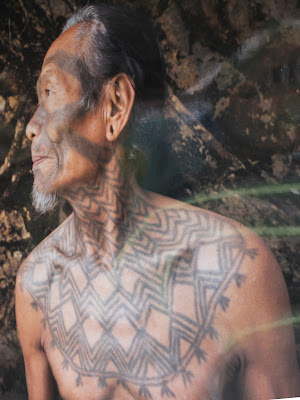

The largest out of l6 officially recognized tribes in Nagaland, the Konyak are known as ‘those violent headhunters with tattooed faces.’ The Naga tribes head hunt not because of mass killing or purposely  killing people but it happens over dispute over property, fishing rights and for vengeance. Not all men have to go to war. Tattoos are very diverse in Konyak tribes. We have discovered about three tattoo groups, which has not been done by anyone before. The iconic men tattoo you see is the facial tattoo of a particular group. There are other groups with chest and arm tattoos. So basically for the men it is the right of passage or initiation. The warrior gets a distinctive tattoo mark depending upon his role in the battle. We have tattoos for the powerful chiefs. Common people or subordinates cannot get that tattoo. It is a taboo. When a girl turns eight she gets her first tattoo, when she becomes 11years or attains puberty she gets it on her chest, her arms, when she is about to get married she gets it on her knee signifying that she belongs to her husband now and when she is giving birth to a child she gets tattoo on her thighs, that’s for fertility.

Phejin explains, “The tattoo was a tradition for life and as for head hunting began declining tattoo culture receded. My society was the last to transcend into modern times and adjust with modern life. Now it’s not our way of life and we don’t encourage anyone to do it. We document it for preserving the culture of the Nagas. Our work is very precious and if we hadn’t heard their stories we would have never known the tattoo’s significance in their daily life.” Phejin is writing down a book on Konyak culture. Her main aim is to reach the maximum members of the Konyak tribe. There is going to be a series of three books, first for national and international quality, second will be cheap material for localities and third and illustrative children’s book. They will be making a documentary and an animated film. The children’s book will be turned into a documentary. There is only a handful of such full-body tattooed warriors left in Konyak tribes. Peter signs off, “I realized that this kind of tribal existence, visual appearance of it is

disappearing everywhere in the world. I like diversity as a photographer. Now I really feel the urge to go out and capture unique people. I think in a decade or two the world will be completely be changed and then specific unique characteristic of the people will fade out.”


Reviving traditional tattoos of the tribal people of the North East

At Hongpui Village with the former tattooed headhunters, Mon district Nagaland.

Mo Naga, an alumnus of NIFT-Hyderabad is a self-taught tattoo artist. He is reviving traditional tattoos of the tribal people of North-East, creating neo-tribal designs. His designs are exposing to the world the lost tattoos of Northeastern tribes. Recently Mo Naga was present here at an exhibition at the Indian Museum aimed at documenting the traditions of past generations of Konyaks an initiative by Phejin Konyak, a descendant of the tattooed headhunters of the Konyak tribe. She has worked relentlessly for conserving the vanishing art.Renowned Dutch photographer Peter Bos, a collaborator in the research of Phejin Konyak was also present..Abhijit Ganguly spoke to Mo Naga.

You are a qualified Fashion Designer from National Institute of Fashion Technology (NIFT) - Hyderabad. What prompted you to embark on a journey to protect, revive and promote tribal tattoos?

India has a diversified culture of tattoos from Kerala to Himachal Pradesh and from Gujarat to Nagaland, India has existing tattoo traditions. There are many tribes of the Naga community with rich tattoo traditions. I was overwhelmed by the opportunities that lay in front of me. It was the right time for me to shift from textile designing. Tattoos would reconnect me to my roots and give me an opportunity to showcase my work. I wanted to promote indigenous tattoo culture, prevalent among various tribes of the North-East. I am overwhelmed by the response and support that I have received. There is a need for urgency in everyone including the government bodies and the artists to revive the forgotten art of the Nagas which is slowly fading away.
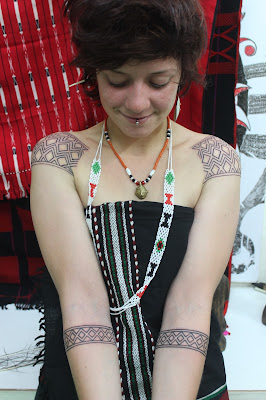
 
Tattoo is a way of expressing
your feelings through your skin- Mo Naga
What is the present scenario of tattoo making?

The tattoo industry is booming in India. Tattoo is a way of expressing your feelings through your skin. For most people a tattoo signifies something deeper, much more personal and meaningful unlike the clothes or the makeup. Five -six years ago, people were fascinated by the bio-mechanical tattoo like, and then came realistic portraits and now people want to get Naga tribal style tattoos. The biggest misconception of tattoo is regarding health. There has to be more awareness about safe, hygienic and international standard tattooing.

What do you think is important for a tattoo artist while making a tattoo?

A tattoo artist must understand design concepts, body aesthetic, must have knowledge of art, and must be able to appreciate different art forms. 

Words of advice for aspiring tattoo artists?

To become a tattoo artist entails a long journey, lot of study, hard work and sincerity. It’s a profession that pays handsomely but is underestimated in society.

How was your experience getting involved with Phejin and Peter?

It was a great learning experience for me personally. I am grateful to Phejin and Sayan Bhattarcharya for arranging the workshop at the Indian Museum. Peter is a great photographer. I had great fun exchanging thoughts with both Peter and Phejin.

1

copyright © . all rights reserved. designed by Color and Code

grid layout coding by helpblogger.com